
Latching is the security, not the lock
A room can have an excellent cylinder and still be open if the door stops short of the strike. We test the behaviour rather than the hardware, because the behaviour is the half that actually fails.
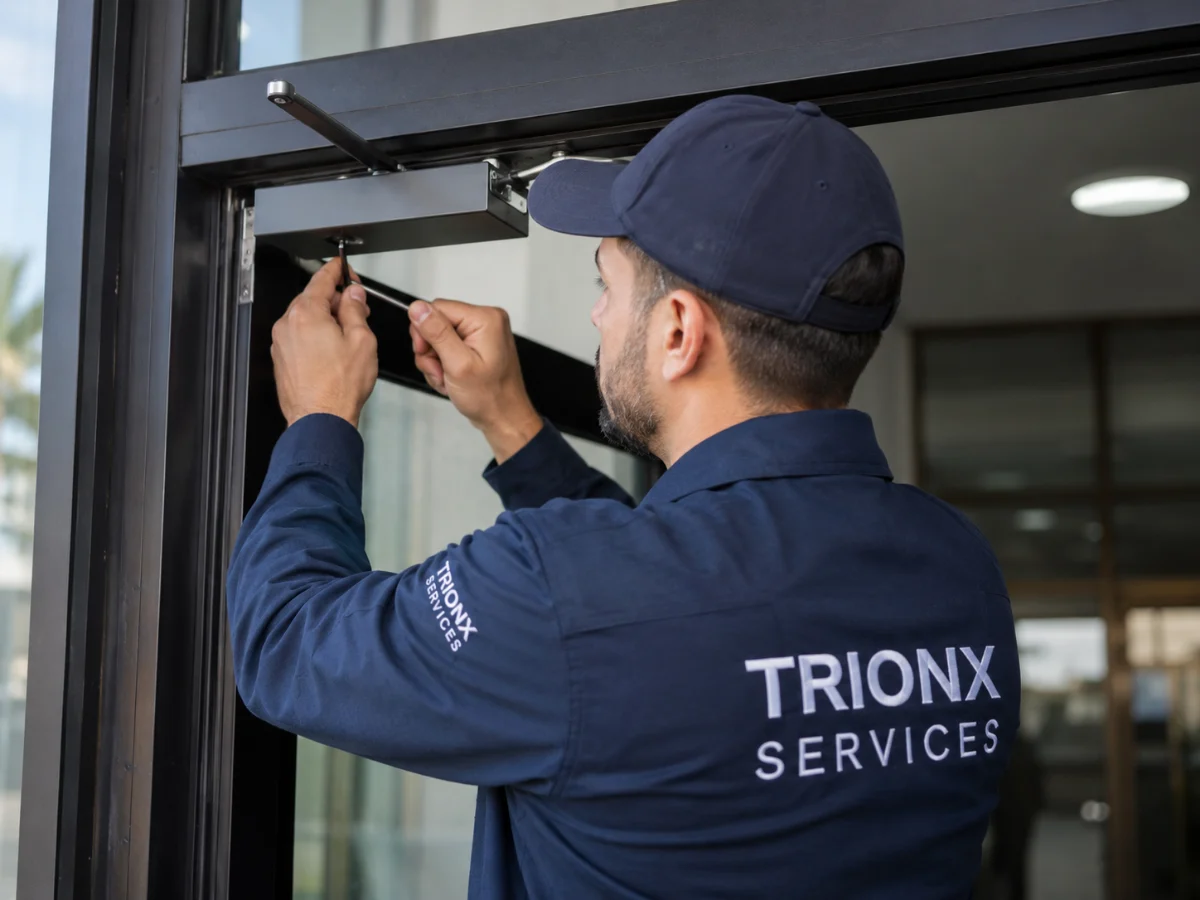
Medical
A controlled room whose door rests against the strike instead of latching is not controlled, and nobody notices until it matters.
Clinic doors carry two requirements at once. Rooms holding records, samples or controlled stock have to latch reliably every single time, and public routes have to stay within accessibility limits on how much force it takes to open them.
Those two pull against each other. A closer wound up to force a stubborn door shut is the usual reason a building fails an opening force check, and it is almost always covering an alignment fault rather than solving one.
What we get called for
Performed in-house
Performed by TrionX employees. No Florida contractor licence is required for this trade, and TrionX carries general liability and workers compensation covering the work.
Why TrionX
A room can have an excellent cylinder and still be open if the door stops short of the strike. We test the behaviour rather than the hardware, because the behaviour is the half that actually fails.
Fix the alignment first, then the seals, then set the closer spring to the lowest value that still latches. Where a door cannot meet both, we say so rather than compromising the latch quietly.
Every technician is a W-2 employee, background checked before attending. On a clinic that matters more than almost anywhere, and it is why the work is not handed to whoever was free.
Common questions
Treat it as a security failure rather than a maintenance item. A door resting against the strike is an open door, and the lock is irrelevant. The cause is normally a dropped hinge or a weakened closer spring, and it is usually fixed on the first visit.
The figure most often cited for interior hinged doors on an accessible route is five pounds. It applies to the door in service rather than on the day it was installed, and doors drift past it quietly, usually because a closer was wound up to force a latch.
Yes, and for anything noisy or blocking a corridor it is the only workable option. Most closer and alignment work is under an hour per opening, so evenings and closed days suit it well. Tell us the schedule so it is priced that way.
The door hardware, closers, latching and alignment around them are ours. The operator itself is powered equipment involving wiring, which is licensed electrical work in Florida at any job size, so an electrician handles that part and we coordinate both.
Further reading
Written for the people who have to make the call. More in our insights, and the vocabulary in the glossary.
Related
We test the behaviour rather than the hardware, fix the alignment before touching the closer, and keep accessible routes within opening force limits. Background-checked employees, planned around your clinic hours.