

Doors
Why commercial doors drop, and what alignment actually involves
A door that scrapes the frame, sticks at the top corner or has stopped latching is rarely a broken door. It has moved, and something moved it.
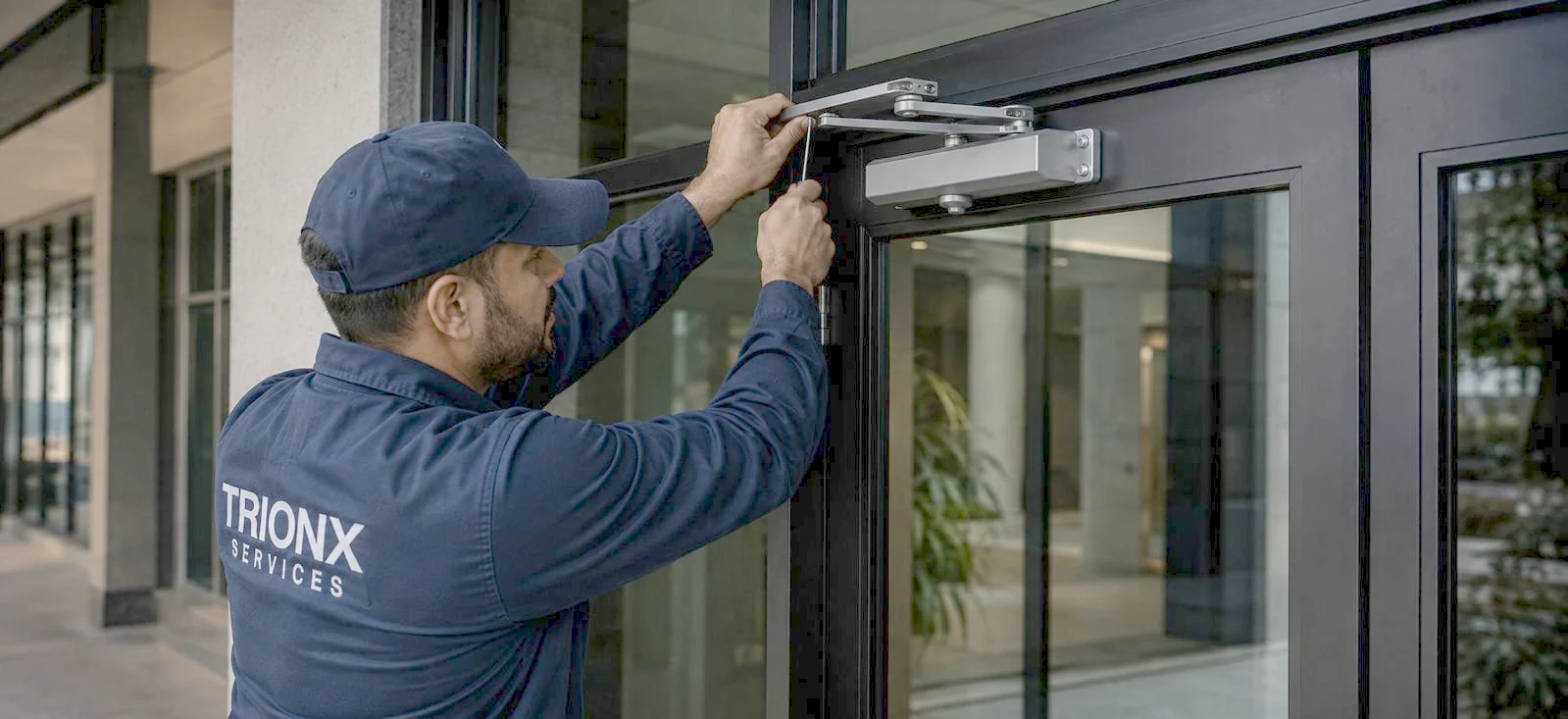
Alignment is the most common door fault we attend and the one most often misdiagnosed. The symptoms look like hardware failure, so a closer or a lock gets replaced, the problem persists, and the new part gets blamed.
What alignment actually means
A door hangs in a frame with clearances measured in millimetres. There is a gap at the hinge stile, a gap at the lock stile, a gap at the head and a gap at the threshold, and the latch has to meet the strike squarely within that. Move any part of the assembly and the geometry stops working.
The door does not have to move much. Two or three millimetres of sag at the top of the lock stile is enough to stop a latch engaging, and it is invisible to the eye.
What makes a door drop
Hinge wear. The commonest cause by a distance. Every opening puts the whole weight of the door on the hinge pins, and on a commercial entrance that is hundreds of cycles a day. Worn knuckles and pins let the door sag toward the lock side.
Screws pulled out of the frame. The top hinge carries the most load, and its screws work loose or strip out of the jamb over time. A door that has dropped often needs the fixings dealt with rather than the hinges replaced.
The frame itself moving. In older Miami buildings the frame moves with the structure, with settlement, and with the expansion and contraction that comes from big daily temperature swings on an exterior wall. The door is fine and the opening changed shape around it.
Impact. Trolleys, deliveries, wind catching an exterior door and slamming it back into the stop. A single hard event can bend a hinge, distort a frame or twist a door leaf.
Threshold and floor changes. New flooring laid over old, a threshold that has lifted, or a floor that has moved. The door binds at the bottom and everything else is fine.
The closer fighting it. A closer adjusted too aggressively to force a stubborn door shut puts a constant load into the top of the door and accelerates every problem above.
Diagnosing it in five minutes
The checks a facilities manager can do before calling anyone:
- Look at the gap all the way round. It should be even. A gap that is wide at the top of the lock stile and tight at the bottom means the door has dropped.
- Watch the latch approach the strike. Close it slowly by hand. If the latch hits the strike plate high, low or on its edge, that is alignment rather than hardware.
- Check for rub marks. Bare metal or worn paint on the frame or the threshold tells you exactly where it is binding.
- Lift the door at the handle. If the geometry improves when you take the weight, the hinges or their fixings are the problem.
- Open it and let it go. If it fails to latch under its own power, and the gap is uneven, do not adjust the closer. Fix the alignment first.
What the repair involves
Alignment work is a sequence rather than a single fix, and it goes in this order.
Fixings first. Loose or stripped hinge screws get dealt with before anything else, because everything downstream depends on the hinges being solidly fixed. Stripped holes in a timber jamb need filling and re-drilling rather than a longer screw driven into the same hole.
Hinges next. Worn hinges get replaced, and on a high-traffic commercial door a continuous hinge is frequently the right answer because it spreads the load along the full height instead of concentrating it on three points. It costs more once and removes the recurring call.
Then the strike. Once the door hangs correctly, the strike plate is adjusted or repositioned so the latch meets it squarely. Filing a strike to make a misaligned door latch is a temporary fix that makes the real fault harder to see later.
Threshold and seals last. Weatherstripping and thresholds get set to the corrected geometry, not the old one.
Closer adjustment at the end. With the door hanging and latching correctly, the closer can be set to a sensible sweep and latch speed rather than being wound up to overcome a mechanical problem.
When the door or frame is beyond adjustment
A twisted leaf, a frame distorted by impact, or a door that has been packed and shimmed by successive repairs to the point where nothing sits true, all reach a point where replacement is cheaper than continuing to chase it. We say so rather than adjusting it again, and we say it at survey rather than after the third visit.
Why it matters beyond the annoyance
An unlatched door is an open door, so the security on that opening is gone regardless of the lock fitted. On a fire rated assembly it is more serious, because the rating depends on the door closing and latching under its own power from any angle, and an inspector tests exactly that. On an accessible route, a door binding in its frame raises the opening force, which is the usual reason a building fails that check.
Where this sits for us
Doors and hardware are performed by our own technicians. No Florida contractor licence is required for this work, so the person who surveys the door is the person who fixes it, and TrionX carries general liability and workers compensation covering it. Every visit leaves photographs, the hardware recorded, and the closer settings noted, so the next person to touch that door knows where it was left.
Common questions
Questions we get asked about this
Why has my commercial door stopped latching?
Most often the door has dropped, so the latch no longer meets the strike squarely. Worn hinges or hinge screws pulled out of the frame are the usual causes. Adjusting the closer to force it shut treats the symptom and accelerates the underlying wear.
How can I tell if a door is out of alignment?
Look at the gap around the whole door: it should be even. A gap wide at the top of the lock stile and tight at the bottom means it has dropped. Close it slowly and watch whether the latch hits the strike high, low or on its edge.
What is a continuous hinge and when is it worth fitting?
A hinge running the full height of the door instead of three separate knuckles, so the weight spreads along the whole edge. On a high-traffic commercial entrance it usually pays for itself, because the concentrated load at three points is what causes the door to drop in the first place.
Does door alignment work need a licensed contractor in Florida?
No. Doors and hardware require no Florida contractor licence, which is why TrionX performs this work with its own W-2 employees rather than coordinating it, and carries general liability and workers compensation covering it.
Keep reading
Related field notes

One company, whoever does the work
Our technicians handle the trades that need no state licence, and licensed contractors handle the ones that do. Either way we scope it, book the visit and file the record. Tell us the property and the problem and we will come back with a window.