
The test is behaviour, not appearance
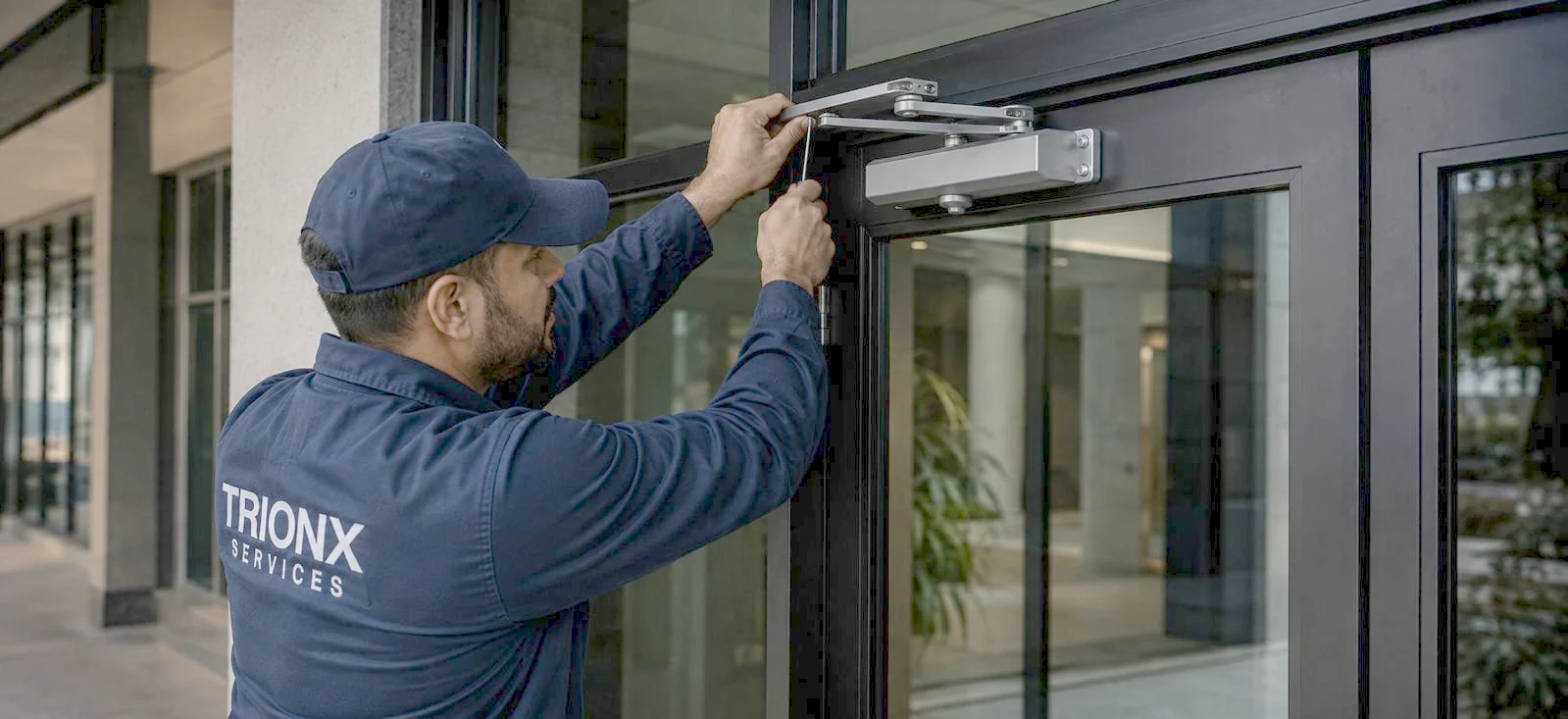
Open the door fully, let it go, and watch. If it stops short, rests against the strike or needs a push, the assembly has failed. An inspector does exactly that and so can a manager on a walk.
Condo and HOA
A corridor door that closes but does not latch has lost its fire rating while looking completely normal, and most buildings have several.
Corridor and stairwell doors in a multi-family building are rated assemblies, and the rating depends on the door closing and latching under its own power from any angle. Constant use is what takes that away, and nothing about the door looks different when it happens.
The other recurring problem is propping. Residents and contractors wedge doors for moving, deliveries and airflow, and a wedged fire door is the finding inspectors record most often.
What we get called for
Performed in-house
Performed by TrionX employees. No Florida contractor licence is required for this trade, and TrionX carries general liability and workers compensation covering the work.
Why TrionX
Open the door fully, let it go, and watch. If it stops short, rests against the strike or needs a push, the assembly has failed. An inspector does exactly that and so can a manager on a walk.
Where a door genuinely needs to stand open, the answer is a device that releases on alarm activation. Wedges are always there for a practical reason, which is worth solving rather than just removing.
We number the doors, record what was checked and what was done, and hand it over. An inspection record referring to a corridor door on a floor with six of them is nearly useless a year later.
Common questions
On a rated assembly it is a failure. The rating depends on the door latching under its own power from any angle, so a door resting against the strike does not hold. It is the finding inspectors record most often and it usually traces to alignment or a weakened spring.
Fit a hold-open device that releases on the fire alarm, so the door can legitimately stand open and still close when it matters. Removing wedges without addressing why they appear means they come back within the week.
No. We repair and maintain the hardware, meaning closers, hinges, latches, alignment, seals and coordinators, which requires no Florida contractor licence. We do not issue certification, and our record does not replace a formal inspection where one is required.
Corridors, stairwells, lobbies and amenity spaces are normally common elements and therefore association responsibility. A unit entry door is frequently a limited common element with responsibility split, so the governing documents decide it and our report identifies which side the failure sits on.
Further reading
Written for the people who have to make the call. More in our insights, and the vocabulary in the glossary.
Related
Closers, latching, coordinators and hold-open devices are performed by our own employees, with each door numbered and the result written down. Association or unit owner responsibility identified in the report.