

Building
The commercial hurricane preparation checklist
Most storm damage on commercial property starts with something that was already loose, already blocked or already failing before the season began.
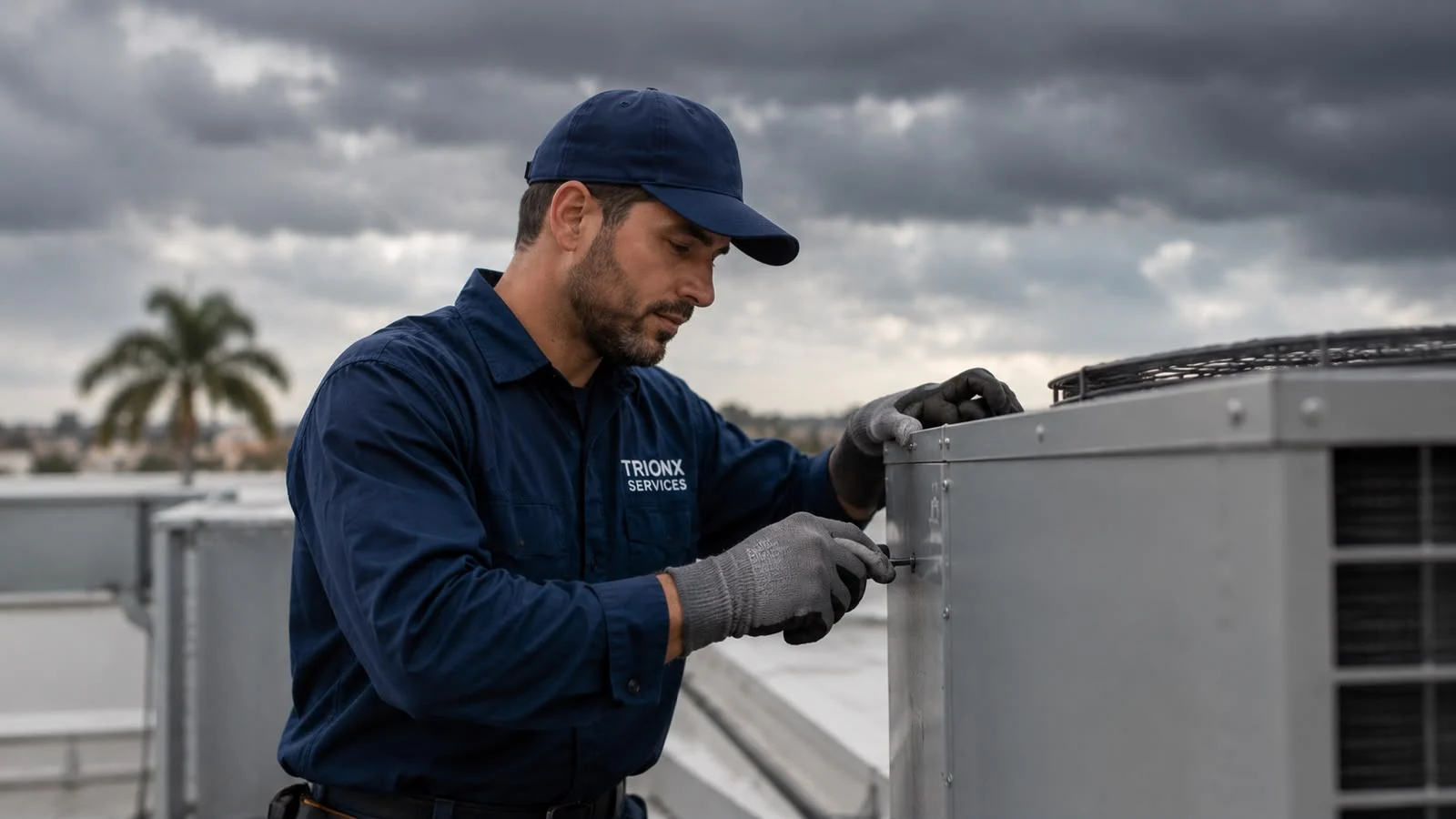
Hurricane season runs 1 June to 30 November. The work that determines how a building comes through it mostly happens in May, and the work that determines whether the claim pays happens with a camera.
May: the preparation that matters
Roof and drainage. Clear every drain, scupper, gutter and downpipe. Blocked drainage is the single most common route for storm water into a building, and it is the cheapest thing on this list to fix.
Anything loose on the roof. Flashing, old filters, offcuts, unsecured equipment covers, abandoned fixings. Every one becomes a projectile, and the thing it most often hits is a condenser coil.
Rooftop equipment fixings. Confirm units are actually secured to their curbs the way the installation intended and that fasteners have not corroded. Coastal properties should expect corrosion and plan for it rather than treating it as a defect.
Sealant joints. Window and door perimeters, expansion joints, parapet and coping joints, penetrations. Repair failures before the rain rather than after, because a failed joint is a direct path into the wall for driven water.
Glazing and openings. Confirm which openings are impact rated and which rely on shutters. For shutters, confirm they are present, complete, and that somebody knows how to deploy them and how long it takes.
Doors. Every exterior door should close and latch under its own power. A door that does not latch will open in wind, and once an opening fails the internal pressure changes and the damage escalates.
Trees and site. Anything overhanging the building, and anything in the yard that is not fixed down.
May: the documentation
This is the part that decides claims, and it takes an afternoon.
- Photograph every elevation, the roof, all rooftop equipment, the yard and the interior, dated
- Record model and serial numbers for major equipment, because post-storm everyone is sourcing the same parts and having the details moves you up the queue
- Confirm your insurance position, limits, deductible and what your policy requires you to do to mitigate
- Write down who does what: who isolates equipment, who deploys shutters, who holds which keys, and who is the decision maker if they cannot be reached
- Keep a copy off site and not only on a machine in the building
The 48 hours before landfall
Short list, mostly not technical, and it needs to be executable by whoever is available rather than by a specialist.
- Photograph everything again. This is what establishes condition immediately before the event, and it is the single most valuable thing you can do.
- Deploy shutters or protection on openings that need it, allowing far more time than you expect.
- Clear the roof and the yard of anything that has appeared since May.
- Secure or remove exterior furniture, signage and bins.
- Move stock and equipment away from openings and off the floor where flooding is plausible.
- Execute the shutdown plan for equipment, isolating at the disconnect where that was the decision, and confirm who is doing it.
- Check drainage one last time.
After: what to do first
Safety before assessment. Do not enter a damaged building until it is safe, and treat any electrical hazard, standing water near power, or structural concern as a reason to wait for someone qualified.
Photograph before touching anything. Wide shots and close shots, everything, including things you think are undamaged. It is far easier to discard photographs than to recreate them.
Mitigate. Stop water coming in, board broken openings, secure the building. Most policies expect reasonable steps to limit damage, and failing to take them can prejudice the claim. Board-up is dispatched around the clock for exactly this reason.
Then assess properly, and expect the damage to be less obvious than you hoped.
The failures that arrive later
The expensive post-storm problems are rarely the visible ones. Equipment that runs after a storm is not necessarily undamaged, and three patterns recur.
Immediately: things that will not start, usually electrical, from water in a disconnect or surge damage.
One to two weeks: capacity problems, typically debris in a condenser coil, where the unit runs and cools inadequately while drawing more current than it should.
Three to eight weeks: compressor failure, from running against high head pressure on a coil nobody cleaned.
A post-storm inspection is therefore worth considerably more than a post-storm repair. A coil cleaned in week two prevents a compressor replaced in week six.
The claim
Claims are decided on evidence. An adjuster wants a clear before and after: condition beforehand, damage after, and what was done about it, with dates. The May photographs are frequently what makes the difference, because they establish that damage was storm related rather than pre-existing deterioration.
Keep the parts detail too. "Replaced compressor" is far weaker than a documented model and serial, the failure mode observed, and photographs of the failed component.
Who does what
Board-up, door and lock repair, glass, drywall and making good, painting and sealing are performed by our own W-2 employees and require no Florida contractor licence, which is why they can move immediately after a storm when everything else is booked.
Roofing, structural, electrical, plumbing, HVAC and refrigeration all require a licensed contractor in Florida at any job size. We scope those, verify licence and insurance, coordinate the attendance and keep the record, which after a storm is the scarcest resource of all.
Common questions
Questions we get asked about this
What should a commercial property do in May before hurricane season?
Clear all roof drainage, remove anything loose from the roof, check rooftop equipment fixings for corrosion, repair failed sealant joints, confirm openings are protected, check every exterior door latches under its own power, and photograph everything with dates.
What matters most in the 48 hours before landfall?
Photographing everything again, because that establishes condition immediately before the event and is what decides a claim. Then deploying protection, clearing the roof and yard, securing loose items, moving stock away from openings, and executing the equipment shutdown plan.
Our equipment runs after the storm. Is it undamaged?
Not necessarily. Failures arrive in waves: electrical faults immediately, capacity problems within one to two weeks from debris in a condenser coil, and compressor failures three to eight weeks later. A coil cleaned in week two prevents a compressor replaced in week six.
What does an adjuster need after a storm?
A clear before and after with dates: condition beforehand, the damage, and what was done about it. Pre-season photographs are frequently what establishes damage was storm related rather than pre-existing. Keep model, serial and failure detail rather than just a line saying what was replaced.
Keep reading
Related field notes
One company, whoever does the work
Our technicians handle the trades that need no state licence, and licensed contractors handle the ones that do. Either way we scope it, book the visit and file the record. Tell us the property and the problem and we will come back with a window.