

Electrical
What legally needs a licensed electrician in Florida
The most expensive misunderstanding in commercial maintenance is the belief that small electrical jobs are exempt. There is no size threshold. There never was.

This is the boundary that decides who is allowed to touch a job, and it is drawn in a place that surprises most property managers. Getting it wrong exposes a building owner to uninsured work, voids warranties, and creates a problem at the point of sale or at a claim.
We write about it plainly because our own business model depends on the line being clear: TrionX performs six trades directly and coordinates this one, and we would rather explain why than be vague about it.
There is no minor-scale exception
Florida requires a licensed contractor for electrical work regardless of the size or value of the job. A three hundred dollar fix needs a licensed electrician exactly as much as a thirty thousand dollar one.
This is the single most common misconception we encounter. The assumption that a small job, a like-for-like swap, or a repair rather than an installation somehow falls outside it is wrong, and it is wrong in a way that only becomes visible when something goes badly.
What counts as electrical work
The scope is wider than people expect. All of the following require a licensed electrician on commercial property in Florida:
- Replacing outlets, switches and dimmers
- Replacing or installing light fixtures where wiring is connected
- Ceiling fan installation and replacement
- Anything touching a ballast or an LED driver, including most retrofit work
- Circuit work, panel work, breakers and disconnects
- Running new cable or extending existing circuits
- Power supplies for access control, gate operators and automatic doors
- Emergency and exit lighting where the fixture, its wiring or its battery circuit is involved
- Dedicated equipment circuits, three-phase work and anything at the service
The outlet and switch line is the one that catches people. Swapping a worn receptacle looks like the definition of a small maintenance task, and it is licensed work.
What a maintenance technician may do
The genuine exceptions are narrower than the list above and they share a common feature: nothing is disconnected or reconnected.
- Relamping. Changing a lamp in an existing fixture, where the fixture and its wiring are untouched.
- Cleaning and diffusers. Removing, cleaning and refitting a diffuser or lens.
- Mounting with no wiring involved. Fixing something to a wall or ceiling where no electrical connection is made.
- Resetting a breaker that has tripped, once. If it trips again, that is a fault and it needs an electrician.
- Testing and recording emergency lighting operation, as an observation, without working on the fixture.
Beyond that the honest answer is a licensed contractor, and a maintenance vendor telling you otherwise is telling you something about how they run the rest of their work.
Permits are a separate question
Licensing and permitting are two different requirements and both can apply. Some electrical work needs a permit and inspection on top of needing a licensed contractor, and permitted work brings a submittal, an inspection and a record.
The practical implication is that a job can be legal on licensing and still be unfinished on permitting, and a building sold with unpermitted electrical work is a problem that lands on whoever owns it at the time.
What it costs to get wrong
Insurance. A claim traced to unlicensed electrical work is a bad conversation. Cover can be affected both for the property owner and for whoever performed it.
Liability. An injury or a fire connected to work performed by somebody not licensed to perform it puts the party who engaged them in a very exposed position.
Sale and diligence. Unpermitted or unlicensed work surfaces during diligence, and it is priced into the deal against you.
Warranty. Equipment warranties routinely require installation by a licensed contractor, and non-compliant installation voids them.
How to check a contractor
Ask for the licence number and verify it directly with the Florida Department of Business and Professional Regulation rather than accepting a photograph of a card. Confirm the licence is current, in the right category for the work, and held by the entity actually attending rather than by a company they subcontract from. Then get a certificate of insurance naming the correct entity, and confirm workers compensation is in place.
Doing that once per contractor takes about ten minutes and it is the whole defence.
How TrionX handles it
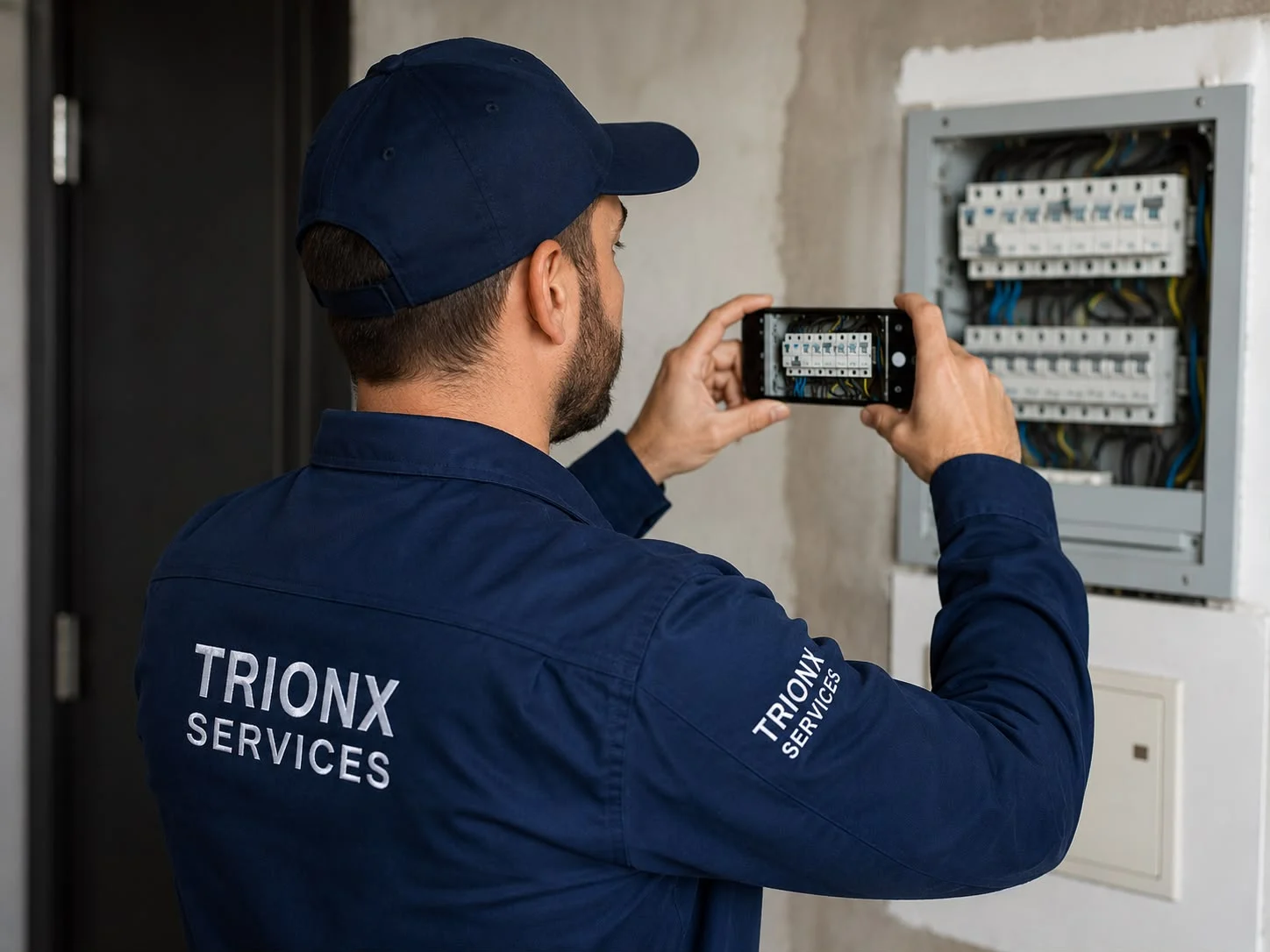
We do not perform electrical work and we do not hold a Florida contractor licence. What we do is scope the fault properly so the electrician arrives knowing what they are attending, verify the licence and the certificate of insurance before anyone sets foot on your property, arrange access and scheduling, and file the documentation afterwards.
That is a service rather than an apology. The trades we perform directly, meaning locks and access control, doors and hardware, glass, carpentry, painting and general maintenance, require no Florida contractor licence, which is precisely why we can perform them with our own W-2 employees. Where the law requires a licence, we bring in someone who holds one, and we say so on every page where it applies.
Common questions
Questions we get asked about this
Is there a minimum job size before electrical work needs a licence in Florida?
No. Florida requires a licensed contractor for electrical work regardless of size or value, with no exception for small jobs. A three hundred dollar fix needs a licensed electrician exactly as much as a thirty thousand dollar one, and assuming otherwise is the most common misconception we meet.
Can a maintenance technician replace an outlet or a light switch?
No. Replacing outlets, switches, dimmers and light fixtures where wiring is connected is licensed electrical work in Florida. Swapping a worn receptacle looks like a small maintenance task and it is not one, which is the boundary that catches most property managers out.
What lighting work can be done without an electrician?
Relamping an existing fixture, cleaning and refitting diffusers, mounting where no electrical connection is made, and observing and recording emergency lighting operation. Anything touching wiring, a ballast or an LED driver, including most retrofit work, requires a licensed electrician.
How do I verify an electrical contractor is licensed?
Ask for the licence number and check it directly with the Florida Department of Business and Professional Regulation rather than accepting a photograph of a card. Confirm it is current, in the right category, and held by the entity actually attending, then get a certificate of insurance naming that entity.
Keep reading
Related field notes


One company, whoever does the work
Our technicians handle the trades that need no state licence, and licensed contractors handle the ones that do. Either way we scope it, book the visit and file the record. Tell us the property and the problem and we will come back with a window.