
Carpentry
Drywall repair after a leak, done so it does not come back
Almost every water-damaged wall we are called back to was patched while it was still wet. The repair was fine. The timing was the problem.
Water damage in a commercial building is two jobs pretending to be one. There is the leak, and there is the drywall. Doing the second before the first is finished is the reason the stain comes back.
Find the source before touching the wall
A stain shows you where water arrived, not where it came from. Water travels along the top of a ceiling grid, down the face of a stud, along a pipe and across a slab before it appears, and the visible mark can be several metres from the failure.
In Miami commercial property the usual sources are a condensate line on an air conditioning unit, a roof or parapet detail, a failed sealant joint on an elevation, a supply or waste line in a riser, and a fire sprinkler fitting. Only the first and last of those are obvious from inside.
Repairing the drywall without finding which one it was is a decision to do the work again.
Establish whether it is actually dry
A wall can look and feel dry on the surface while the cavity behind it is not. Drywall wicks moisture upward from a wet base plate, insulation holds water far longer than the board does, and painted surfaces dry from the front while the back stays saturated.
The practical checks:
- A moisture meter reading, not a hand. Take readings at several heights and compare against an unaffected wall in the same room, because ambient humidity here means no absolute number tells you much on its own.
- Behind the skirting or base. Water sits at the bottom. If the base plate area reads high, the wall is not dry however good the middle looks.
- The insulation. If the cavity has insulation and it got wet, it needs removing. It holds water against the board and dries far more slowly than anything around it.
- Smell. A musty room with a dry-looking wall usually means water somewhere it has not been found yet.
Cut back further than the stain
The visible mark understates the affected area, because water spreads through the board before it shows. Cut back to sound, dry material and square the opening to the studs so the patch has something to fix to.
Cutting to the stain line and no further is why patches show a shadow six months later: the board immediately around the repair was already compromised and continues to move differently from the new material.
Deal with what the water did to everything else
The board is rarely the only casualty. Check and address, in this order:
Insulation. Remove and replace anything that got wet.
Framing. Metal studs are generally fine and may show surface corrosion. Timber that stayed wet needs assessing, and where it has softened that stops being a drywall job.
Mould growth. Surface growth on the back of board that is being removed anyway is part of the strip-out. Anything beyond a small area, or growth on structure rather than on finishes, needs a remediation specialist rather than a maintenance technician, and we say so rather than painting over it.
Adjacent finishes. Skirting, trim, flooring at the base of the wall and the ceiling above. Water rarely damages exactly one material.
Patch so the repair does not telegraph
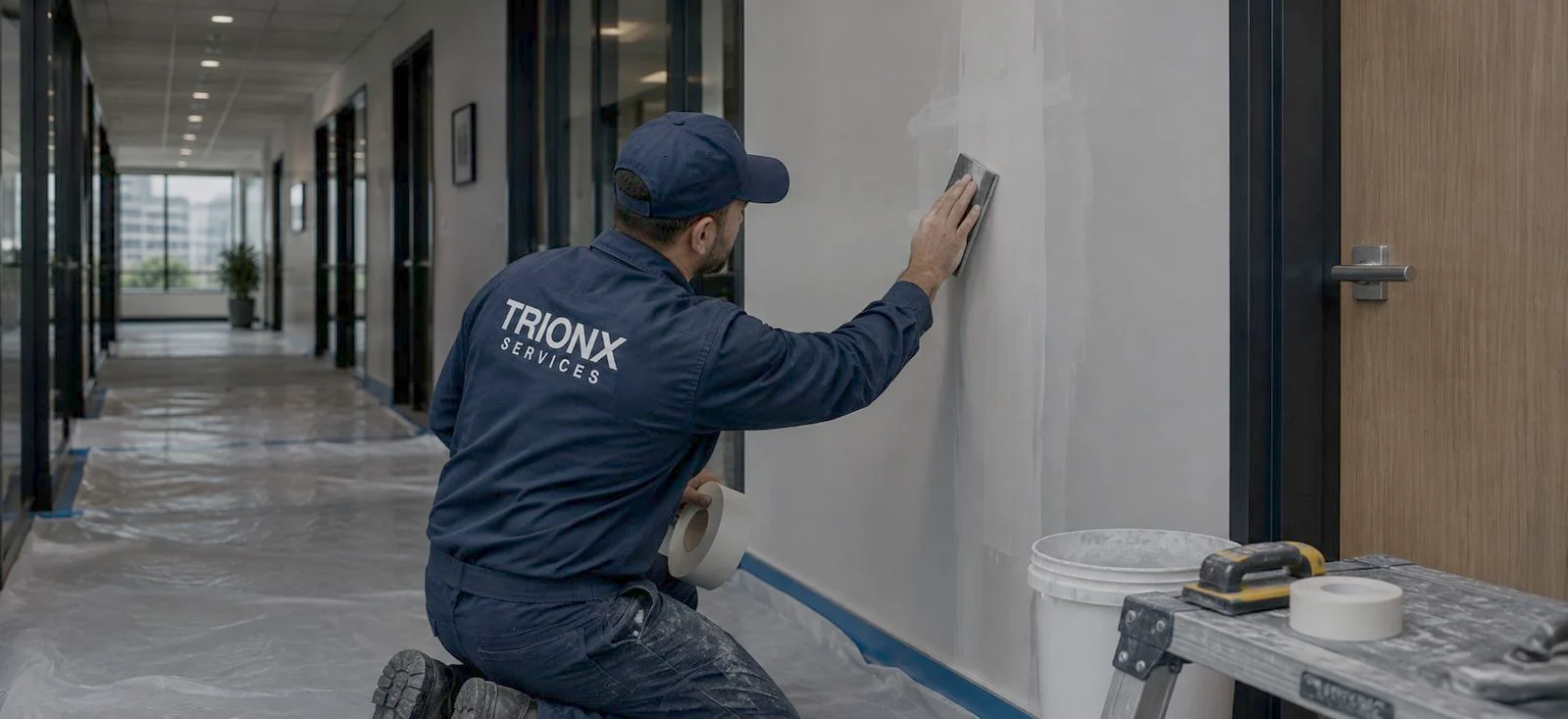
A patch that shows is a patch that was rushed. The things that make the difference are unglamorous: matching board thickness, backing the joint properly, taping rather than relying on filler alone, three thin coats rather than one thick one, feathering wide enough that the transition falls outside the light, and sanding between coats.
Texture matching is the part most often got wrong on commercial work. An orange peel or knockdown finish has to be matched in both pattern and coarseness, and it is worth doing a sample on a scrap before touching the wall.
Prime the stain, or it will come through
Water stains bleed through ordinary paint no matter how many coats go on, because the discolouration is a soluble tannin or rust deposit rather than a surface mark. A stain-blocking primer over the affected area is what stops it, and skipping it is the most common reason a repaired ceiling shows a ring again a month later.
Repaint to a break, not to the patch
Paint on an existing wall has faded, and a fresh patch of the same colour will not match it. Repainting to a natural break, meaning a corner, a shadow gap or a full wall, is the difference between a repair you cannot see and one you can see from the door.
Who does what
Drywall repair, insulation replacement, taping, texture matching, priming, painting and the trim and finishes around it are performed by our own technicians, and none of it requires a Florida contractor licence.
The source usually does. A condensate line or an air conditioning fault is HVAC work, a supply or waste failure is plumbing, and a roof or structural detail is roofing. Florida requires a licensed contractor for all of those at any job size. We scope the fault, bring in a licensed contractor who carries their own insurance, and handle the scheduling, access and the documentation, then carry out the making good ourselves once the cause is fixed.
Keep the record for the claim
Water damage frequently becomes an insurance question, and claims are decided on evidence. Photograph the stain before anything is cut, the opening once it is exposed, the moisture readings, what was replaced, and the finished repair. Record the date the source was fixed separately from the date the drywall was made good.
That sequence, with dates, is what establishes the damage was sudden rather than long-term seepage, and it is the distinction most commercial policies turn on.
Common questions
Questions we get asked about this
Why does my water stain keep coming back after repainting?
Two likely reasons. Either the source was never fixed, so water is still arriving, or the stain was painted without a stain-blocking primer. Water discolouration is a soluble deposit rather than a surface mark, and it bleeds through ordinary paint however many coats go on.
How do I know if a wall is dry enough to repair?
Take moisture meter readings at several heights and compare them against an unaffected wall in the same room, because Miami humidity means no absolute figure means much alone. Check behind the base especially, since water sits at the bottom and the middle of a wall dries first.
How far back should water-damaged drywall be cut?
Past the stain, to sound dry material, squared to the studs. The visible mark understates the affected area because water spreads through the board before it discolours, and cutting to the stain line is why patches show a shadow months later.
Do you fix the leak as well as the drywall?
We find and scope it, then it depends what it is. Condensate and air conditioning faults are HVAC, supply and waste failures are plumbing, and roof details are roofing. Florida requires a licensed contractor for all three at any size, so we coordinate those and carry out the making good ourselves.
Keep reading
Related field notes




One company, whoever does the work
Our technicians handle the trades that need no state licence, and licensed contractors handle the ones that do. Either way we scope it, book the visit and file the record. Tell us the property and the problem and we will come back with a window.