
Building
The roof checks worth doing before hurricane season
Almost everything that goes wrong on a commercial roof during a storm was visible on the roof in May.

Hurricane season runs from 1 June to 30 November, and the roof is where most storm damage on commercial property begins. Not because roofs fail dramatically, but because water finds whatever was already loose, already lifted or already blocked, and then keeps going into the building.
A pre-season roof walk takes an hour on most properties. It is not a substitute for a roofing survey and it does not require a roofer to perform, but it catches the majority of what will otherwise become a claim.
Before you go up
Roof access is the most dangerous part of this exercise. Two people, appropriate footwear, nobody near an unprotected edge, and nobody on a roof in wet or windy conditions. If your roof has no permanent guarding at the perimeter, stay well back from it and accept that some of the inspection is done with binoculars from a distance.
Take a camera and take too many photographs. The purpose is partly to find problems and partly to establish the condition of the roof before the season, which is the evidence that separates storm damage from deferred maintenance when a claim is assessed.
Drainage first, because it does the most damage
Blocked drainage is the leading cause of storm damage that has nothing to do with wind. A Miami storm can drop several inches of rain in an hour, and a roof drain that cannot cope holds that water on the roof, where the weight is measured in tons and the water finds every weakness there is.
Clear every drain, scupper and gutter properly rather than lifting the obvious debris off the top. Check that strainers are present and intact, since a missing one lets material straight into the drain body where it is far harder to clear. Look for evidence of standing water in the form of dirt tide marks and staining, because a roof that ponds in ordinary rain will pond badly in a storm.
Anything fixed to the roof
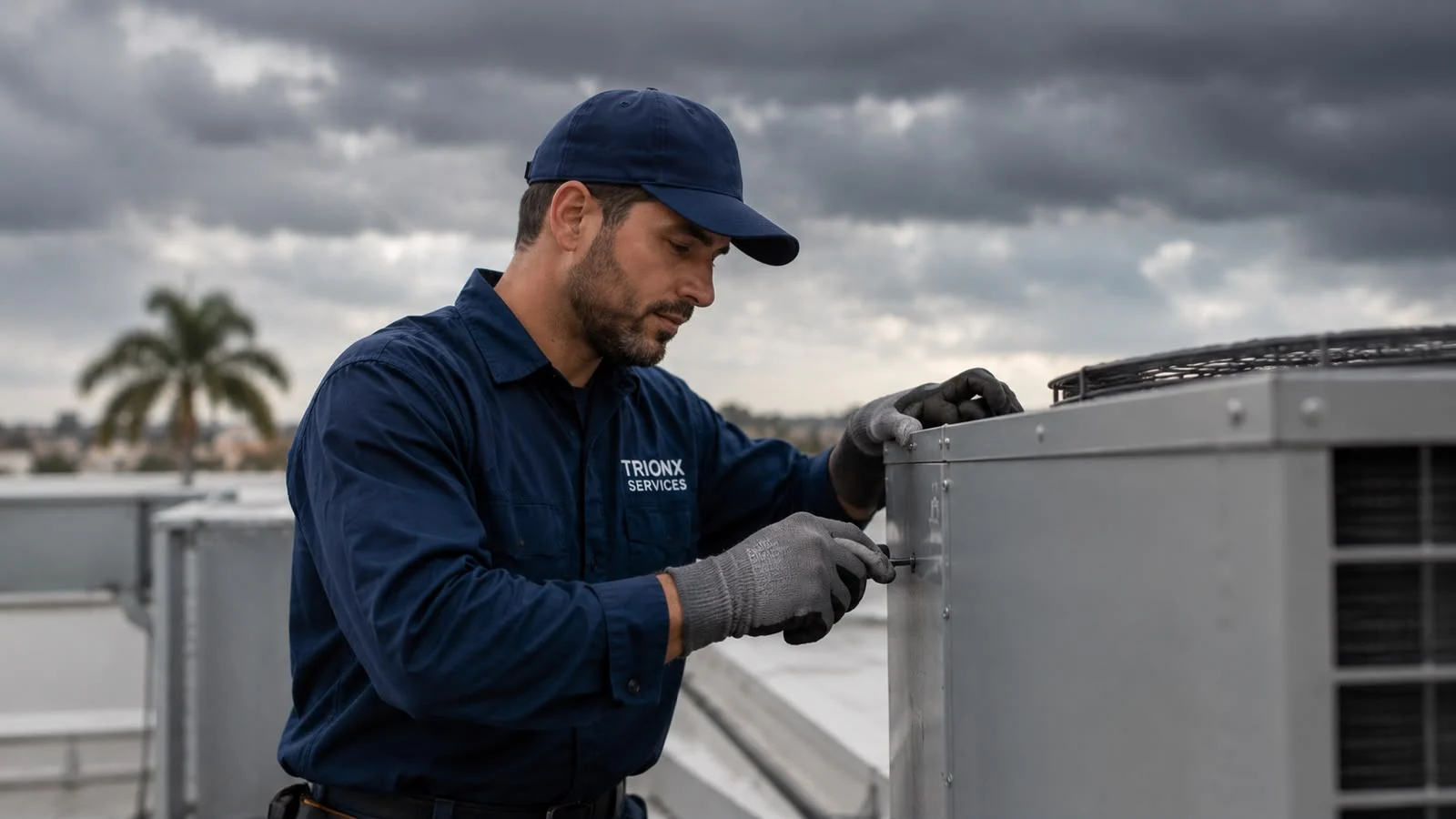
Rooftop equipment is where wind damage starts, and the failures are usually at the fixings rather than in the equipment.
- Curbs and seals. The seal between a unit and its curb keeps water out of the building. Miami sun degrades sealant fast, and a seal that is merely tired in May will not hold under wind-driven rain in August.
- Fastenings. Check units are fixed the way the installation intended and that fixings have not corroded. On coastal property expect corrosion, and treat it as the environment rather than a defect.
- Panels and access doors. A service panel that is not properly latched becomes a projectile and takes a coil or a window with it.
- Cable and pipe supports. Refrigerant lines, conduit and condensate runs on sleepers and blocks work loose over time. Anything that can slide will.
The corresponding equipment checks, including coils, condensate and electrical terminations, are covered in more detail in our note on getting commercial HVAC through a hurricane season.
Edges, flashing and penetrations
Wind lifts a roof at its edges. Walk the perimeter and look for edge metal that has lifted, fasteners backing out, or coping that moves when pressed. A section of edge metal that peels back in high wind can take a wide strip of membrane with it, which turns a repair into a replacement.
Then walk every penetration. Vents, pipes, conduit, old fixings from equipment that was removed and never made good. Each is a hole through the membrane relying on a seal, and old penetrations that no longer serve anything are worth closing properly rather than leaving capped.
The membrane itself
You are looking for blisters, splits, open seams, punctures and areas that have been patched repeatedly. Repeated patching in one spot usually indicates a drainage problem rather than a membrane problem, and patching it again will not change that.
Note anything that has been walked on heavily. Service routes to rooftop equipment take a great deal of foot traffic and are frequently the first areas to wear through. Walkway pads are cheap by comparison.
Clear the roof
Anything loose becomes a projectile. Old filters, offcuts, abandoned equipment, unsecured tools, spare blocks and pavers stacked by a previous contractor. The thing they most often hit is a condenser coil on the same roof.
This is worth doing in May and worth repeating whenever a storm is genuinely inbound, because material accumulates on roofs faster than anyone expects.
What to do with the findings
Sort what you found into three lists. Fix before June: drainage, loose fixings, failed seals, anything that can move. Watch: minor blistering, early wear, small ponding areas. Budget: anything indicating the roof is approaching the end of its service life, which is a planning conversation rather than a June job.
Then file the photographs somewhere they can be found in October. That set, dated before the season, is what establishes the condition of the roof if you later need to demonstrate that a storm caused the damage. It is fifteen minutes of filing that repeatedly decides claims.
Keep reading
Related field notes
Need something looked at?
Tell us the property and the problem, and we will come back with a window.