
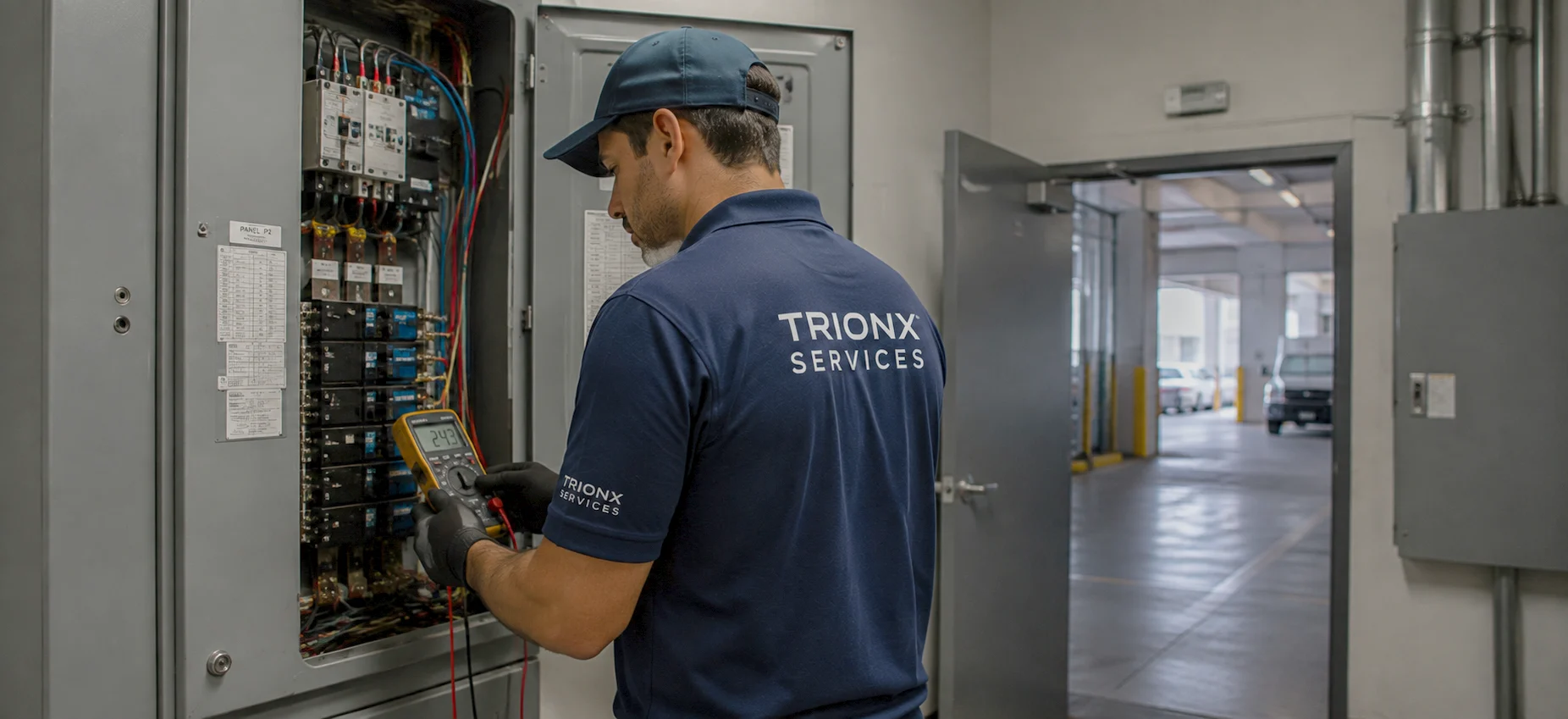
Lighting
Relamping against retrofit: what a technician can and cannot touch
Lighting is the one trade where the licensing line runs through the middle of a single job, and both halves can happen on the same fixture on the same day.
Most trades sit clearly on one side of the Florida licensing boundary. Lighting does not. Part of it is ordinary maintenance that any competent technician may perform, and part of it is electrical work that requires a licensed contractor at any job size.
Knowing which half a job falls in changes the cost, the scheduling and who turns up, so it is worth understanding before you raise the work order.
The maintenance half
Work where the fixture and its wiring are untouched:
- Relamping. Changing a lamp in an existing fixture, whether that is a linear tube, a screw-base lamp or a plug-in module.
- Diffusers and lenses. Removing, cleaning and refitting, or replacing a cracked or yellowed diffuser.
- Cleaning fixtures. Which matters more than it sounds, because a dirty fixture in a warehouse can lose a large fraction of its output.
- Mounting where nothing is wired. Fixing a bracket or a fitting where no electrical connection is made.
- Testing and recording emergency and exit lighting operation as an observation.
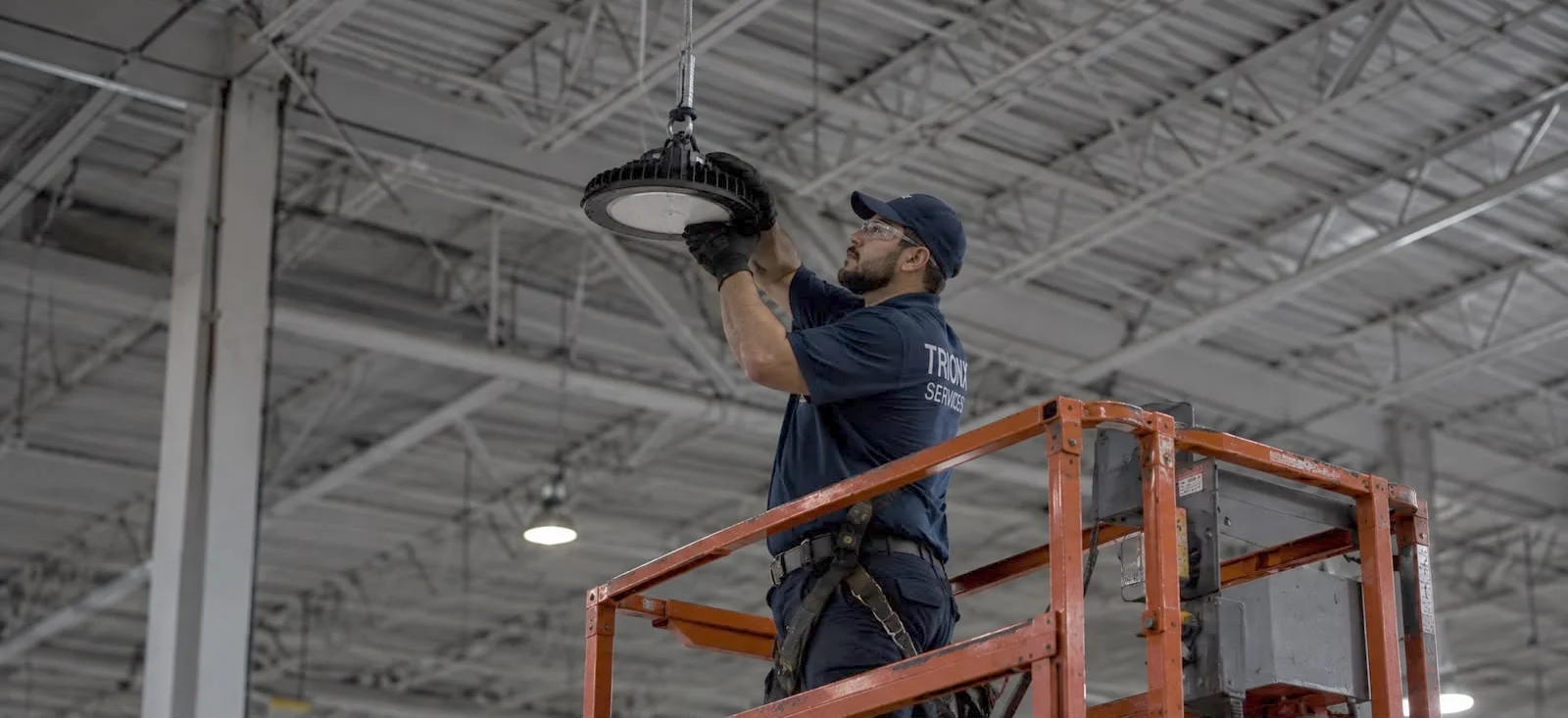
- Access. Getting to the fixture safely, which on a high bay or a lot pole is most of the job.
That work is performed by our own W-2 employees and needs no Florida contractor licence.
The licensed half
Anything where a connection is made or broken:
- Replacing a fixture
- Anything touching a ballast, including removing or bypassing one
- Anything touching an LED driver
- Most LED retrofit work, for exactly the reason below
- Circuits, switching, photocells wired into a circuit, sensors and controls
- Emergency and exit fixtures where the fitting, its wiring or its battery circuit needs work
- Lot pole circuits and anything at a distribution board
All of that is electrical work under Florida law at any job size, so a licensed electrician performs it and we coordinate.
Why retrofit is usually the licensed half
The word retrofit covers several different jobs, and only one of them is maintenance.
A direct-fit lamp that works with the existing ballast is genuinely a relamp. Fit the lamp, done. This is the cheapest version and it is available on a narrower range of fixtures than people hope.
A ballast-bypass lamp requires the ballast to be removed or bypassed and the fixture rewired to feed the lamp holders directly. That is electrical work, every time, however simple it looks.
A retrofit kit replaces the internals of the fixture with an LED array and driver. Electrical work.
A full fixture replacement. Electrical work.
So when a supplier or a consultant says a retrofit is straightforward, the useful question is which of those four they mean, because three of them need a licensed contractor and the quote should say so.
What this means for how you scope a job
The efficient arrangement on a large site is to separate the two halves rather than treating the whole thing as electrical work.
Access equipment is usually the biggest single cost on high bay, corridor and lot lighting, so a scheduled maintenance pass that relamps, cleans fixtures, replaces diffusers and tests emergency lighting in one sweep is worth doing on its own. It needs no licensed contractor, and it catches the failures that would otherwise each become a separate call-out.
Then, where fixtures genuinely need replacing or converting, that becomes a defined electrical package with a licensed contractor, priced as a project rather than as a series of emergencies.
Running it the other way round, where every lighting fault becomes an electrical call, is how a lighting budget gets consumed by access charges.
The one that gets missed
Emergency and exit lighting sits across the line in a way that causes confusion. Testing a fitting and recording whether it operated is an observation, and we do that. If the test fails, fixing it almost always involves the fitting, its wiring or its battery circuit, and that is licensed work.
So a monthly test regime is maintenance and the remediation that follows is electrical. Both belong in the plan, because a testing programme that produces failures nobody is scoped to fix produces a compliance record showing you knew.
How we run it
Our own technicians relamp, clean, replace diffusers, mount fittings where no wiring is involved, and test and record emergency lighting. Where a job crosses into wiring, ballasts, drivers, controls or fixture replacement, a licensed electrician carries it out and we handle the scoping, the licence and insurance verification, the scheduling, the access and the record.
On the same site, on the same day, in the same work order. The point of the split is that you are not managing two vendors, and the point of writing it down is that you know which half you are paying for.
Common questions
Questions we get asked about this
Can a maintenance technician change light bulbs in a commercial building?
Yes. Relamping an existing fixture, cleaning it, and removing and refitting diffusers are maintenance tasks needing no Florida contractor licence, because the fixture and its wiring are untouched. Our own W-2 employees perform that work.
Does an LED retrofit need a licensed electrician?
Usually yes. Only a direct-fit lamp that works with the existing ballast is a genuine relamp. Ballast-bypass lamps, retrofit kits and full fixture replacements all involve making or breaking connections, which is licensed electrical work in Florida at any job size.
Who tests emergency and exit lighting?
Testing a fitting and recording whether it operated is an observation and our technicians do it. If the test fails, the repair almost always involves the fitting, its wiring or its battery circuit, which is licensed electrical work, so that half is coordinated.
How should a large site scope its lighting work?
Separate the two halves. Run a scheduled maintenance pass for relamping, cleaning, diffusers and emergency testing, since access equipment is the biggest cost and that work needs no licence. Then package genuine fixture replacement as a defined electrical project rather than a series of emergencies.
Keep reading
Related field notes

One company, whoever does the work
Our technicians handle the trades that need no state licence, and licensed contractors handle the ones that do. Either way we scope it, book the visit and file the record. Tell us the property and the problem and we will come back with a window.