
Glass
Tempered, laminated or insulated: what belongs in which opening
The three terms get used as though they are interchangeable. They describe different things, and putting the wrong one in an opening is expensive to discover.
Tempered, laminated and insulated are not three grades of the same product. Two describe how the glass is made and how it breaks, and the third describes an assembly. A pane can be more than one of them at once, which is where most of the confusion starts.
Tempered
Tempered glass is heat treated so the surfaces are in compression and the core is in tension. It is several times stronger than ordinary annealed glass of the same thickness, and when it does break it fragments into small blunt pieces rather than shards.
That break pattern is the whole point. It is why tempered is required in locations where a person could walk into it or fall against it: entrance doors, sidelights, low glazing and anything in a wet area.
Two consequences follow from how it is made. It cannot be cut, drilled or modified after tempering, so every hole and edge has to be specified before it is made, which is why a tempered pane is a lead-time item rather than something cut from stock. And it can fail spontaneously, long after installation, from a nickel sulphide inclusion in the original float glass. That is rare and it is not a fault in the installation.
It also offers almost no security. Tempered glass is easy to break and, once broken, the whole pane goes and the opening is completely clear.
Laminated
Laminated glass is two or more layers bonded to an interlayer, usually a plastic film. When it breaks, the fragments stay stuck to the interlayer and the pane holds together in the frame.
That behaviour is what makes it the security and safety choice. A laminated shopfront can be smashed and still be an obstacle, which is the difference between a break-in and an attempted one. It also stays in the opening after impact, which matters overhead and matters enormously in a storm.
Laminated also cuts noise better than a single pane of the same thickness and blocks nearly all ultraviolet, which is why it turns up in hotel frontages on busy streets and in retail where stock fades.
It costs more than tempered and it is heavier, which sometimes means the existing frame and hardware need looking at before it is specified.
Insulated
Insulated glass is an assembly rather than a glass type: two or more panes separated by a spacer with a sealed air or gas gap. It exists to control heat transfer, which in Miami means keeping cooling load down rather than keeping heat in.
The panes inside an insulated unit can be annealed, tempered, laminated or a combination, which is exactly why the three words are not alternatives. A storefront can reasonably be an insulated unit with a laminated outer pane and a tempered inner one.
The characteristic failure is the seal. Once it goes, moisture gets into the cavity and condenses between the panes, and the fogging cannot be cleaned because it is on the inside faces. A failed unit has to be replaced rather than repaired, and it is the single most common glass complaint we get on office property.
Which opening needs which
Entrance doors and sidelights. Tempered as a minimum, because it is a safety-glazing location. Laminated where security matters or the frontage takes impact.
Street-level shopfronts. Laminated is worth the difference. A tempered pane that fails leaves the unit completely open, which is an insurance and security problem before it is a repair.
Interior partitions and office fronts. Tempered generally. Laminated where acoustic separation matters, which in a meeting room it usually does.
Overhead and canopy glazing. Laminated, so that a failure does not drop glass on people below.
Exterior windows on a conditioned building. Insulated units, with the individual panes specified according to the location.
Anything within reach of windborne debris requirements. That is a code question rather than a preference, and it is covered separately in our piece on impact-rated glazing and product approvals.
Why lead times are what they are
None of these can be cut on site. Tempered has to be made to final size with all holes and cutouts in place. Laminated is cut and then processed. Insulated units are assembled to order. So a broken pane means measure, order, wait, then fit, and the wait is the part nobody plans for.
That gap is exactly why emergency board-up exists as a separate job with its own clock. Securing the opening tonight and glazing it properly in two weeks is the normal sequence rather than a compromise.
What we do, and where the line falls
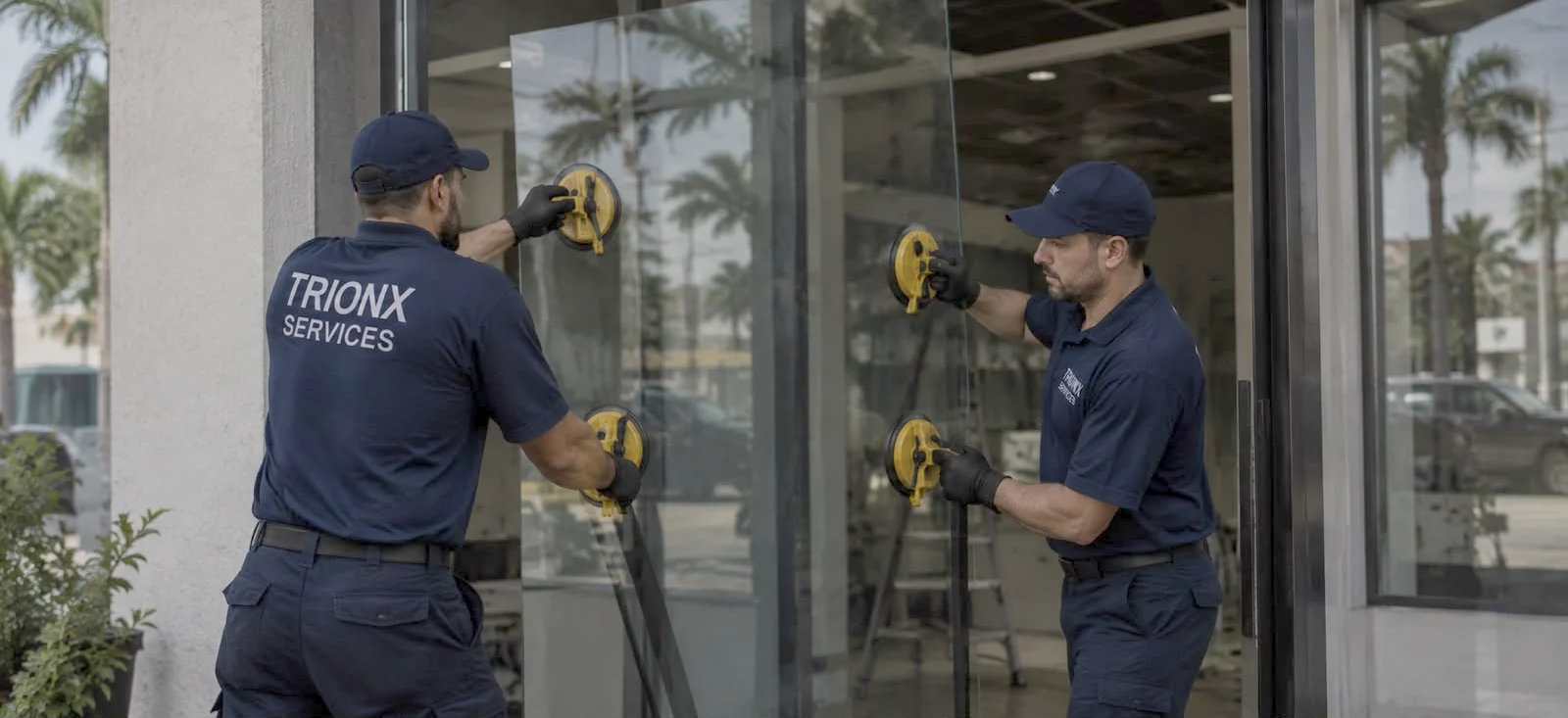
Repair and re-glazing of existing openings is performed by our own technicians, along with emergency board-up, door hardware and the making good around the frame. No Florida contractor licence is required for that work.
A full storefront replacement that needs a permit and a product approval submittal is a different job, and that is coordinated through a licensed contractor. We say which one you are looking at during the survey rather than after the order is placed.
Common questions
Questions we get asked about this
What is the difference between tempered and laminated glass?
Tempered is heat treated so it fragments into small blunt pieces when broken, which makes it a safety product. Laminated is bonded to an interlayer so the fragments stay in place and the pane holds together in the frame, which makes it a security and storm product.
Which glass should a street-level shopfront use?
Laminated is usually worth the extra. A tempered pane that fails leaves the opening completely clear, which is a security and insurance problem overnight. Laminated can be smashed and still be an obstacle, and it stays in the frame after impact.
Why is my double glazing fogged between the panes?
The perimeter seal on the insulated unit has failed, letting moisture into the cavity where it condenses on the inside faces. It cannot be cleaned and it cannot be repaired, so the unit needs replacing. It is the most common glass complaint on office property.
Why does replacement glass take so long to arrive?
None of these types can be cut on site. Tempered must be manufactured to final size with every hole and cutout already in place, laminated is cut then processed, and insulated units are assembled to order. That lead time is why emergency board-up is a separate job.
Keep reading
Related field notes
One company, whoever does the work
Our technicians handle the trades that need no state licence, and licensed contractors handle the ones that do. Either way we scope it, book the visit and file the record. Tell us the property and the problem and we will come back with a window.