

Carpentry
Tenant turnover punch lists: what to fix between tenants
The gap between one tenant leaving and the next arriving is the only window you get. Everything not fixed in it gets fixed later, at a worse price, around somebody trading.
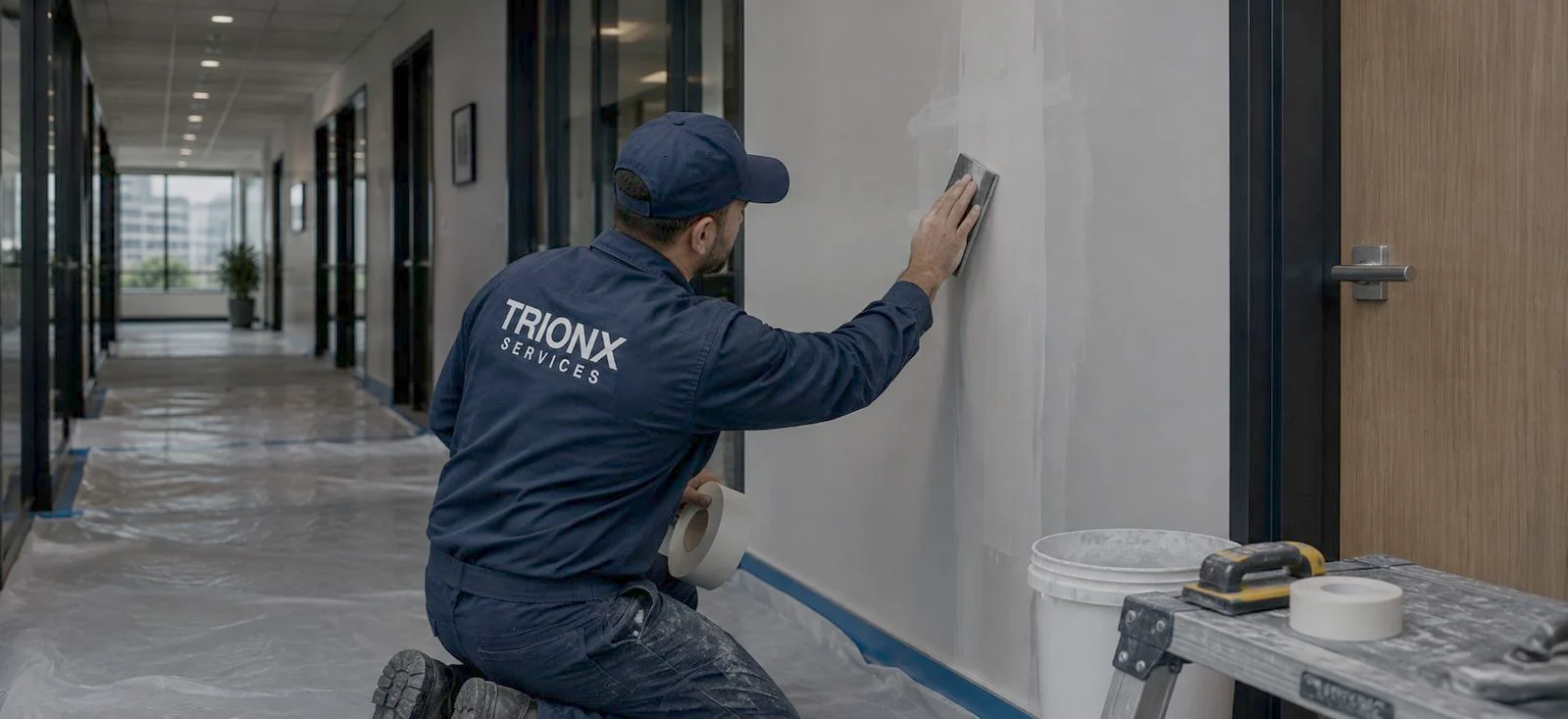
Turnover is the one moment a commercial unit is empty, accessible and nobody is trading in it. Work that would need out-of-hours access, dust screening and a tenant liaison for the rest of the lease is simply a job with a door key.
It is also the moment the unit gets looked at properly for the first time in years, which is why the list is always longer than expected.
Walk it before the tenant is out
The single most useful thing you can do is walk the unit while the outgoing tenant is still in it. Fixtures are still installed, services are still live, and you can see what is theirs and what is yours before anything is stripped out.
Walking an empty unit tells you what is broken. Walking an occupied one tells you what was broken and hidden, which is a different and more expensive list.
Make good after the strip-out
Removing a tenant fit-out leaves damage, and the scope of it depends entirely on how the fit-out was fixed to the building. Expect all of the following.
Anchor and fixing holes. Shelving, wall units, signage and partition tracks all leave fixings. In block and concrete they leave holes that need filling properly rather than smearing over, because a filler that shrinks will telegraph through the paint within weeks.
Partition scars. Where a partition met a wall, a ceiling or a floor there is a line. On the ceiling grid it is usually a run of cut tiles, on the floor it is adhesive or a change in finish, and on the wall it is a strip of different texture.
Ceiling grid damage. Tiles get cut around services and never replaced properly. Grid gets bent where something was hung from it. Both are cheap to fix and very visible to a prospective tenant looking up.
Floor finishes. Adhesive residue, missing tiles, and the patch where a heavy unit stood. Whether this is worth fixing depends on what the incoming tenant will do to it, which is a reason to know who they are before you start.
The items that get missed
These are the ones the incoming tenant finds in week one, which is the worst possible time.
- Door hardware that has been living with a fault. A closer that no longer latches, a lever with play in it, a lock that needs lifting. The outgoing tenant learned to work around it and never reported it.
- Cylinders off the main circulation. Stockrooms, roof access, risers, cages and gate padlocks. They are rarely on the turnover list and they carry the same key exposure as the front door.
- Lamps out in the parts of the unit nobody used. Back corridors, stores, plant spaces. A dark stockroom is the first complaint you will get.
- Silicone and sealant that has failed. Around sinks, splashbacks and window reveals. It reads as neglect out of proportion to the cost of replacing it.
- Ceiling stains. A brown ring is a leak that either is or was, and a prospective tenant assumes it still is. Find out which before painting over it.
Sequence it, because order saves money
Turnover work has a natural order and running it out of order means paying twice.
- Strip-out and clearance, so the actual condition is visible.
- Any investigation: a ceiling stain traced, a door fault diagnosed, a damp patch tested.
- Licensed trades where they are needed, because electrical, plumbing and HVAC work opens up surfaces.
- Carpentry and making good: filling, patching, partition scars, ceiling grid and tiles.
- Painting, once nothing else will damage it.
- Locks and hardware, last, so the unit is secure with a fresh key set from the moment work finishes.
- Final clean and the photographic record.
The commonest and most expensive mistake is painting before the licensed trades have finished. An electrician chasing a wall after decoration means the decoration happens twice.
Where the tier boundary falls
Most of a turnover needs no Florida contractor licence. Drywall and making good, trim, ceiling grid and tiles, shelving, door hardware, locks and rekeying, painting, sealing and relamping are all carried out by our own technicians, who are W-2 employees covered by our general liability and workers compensation insurance.
Electrical, plumbing and HVAC are different. Florida requires a licensed contractor for those at any job size, with no exception for small work, so replacing an outlet, moving a switch or swapping a fixture that involves wiring is licensed work. Anything requiring a permit is too, in any trade. We scope those, bring in a licensed contractor carrying their own insurance, and stay responsible for the scheduling, access and the record.
Knowing which side of that line a job sits on before you start is what stops a turnover stalling halfway through.
Document the condition, twice
Photograph the unit when the outgoing tenant hands it back, and again when the work is complete. The first set settles dilapidations arguments. The second set is what you hand the incoming tenant, and it is what stops a pre-existing mark becoming your problem three months later.
We photograph both ends of every turnover as standard and file the record the same day the work completes.
What a realistic turnover list looks like
For a mid-sized commercial suite in reasonable condition, expect drywall patching in six to a dozen places, a ceiling tile order, two or three door hardware items, a full rekey, a repaint of the areas that need it rather than the whole unit, sealant renewal in the wet areas, and a relamp of whatever is out.
Anything beyond that is either damage the outgoing tenant should be charged for, or deferred maintenance the turnover has finally exposed. Both are worth naming separately in the quote, because they come out of different budgets.
Common questions
Questions we get asked about this
What should be on a commercial tenant turnover punch list?
Making good after the strip-out, ceiling grid and tiles, door hardware faults, a full rekey including stockrooms and roof access, sealant renewal, relamping, and painting the areas that need it. Anything beyond that is either chargeable damage or deferred maintenance the turnover has exposed.
In what order should turnover work happen?
Strip-out, then investigation, then any licensed trades, then carpentry and making good, then painting, then locks and hardware last so the unit is secure with a fresh key set. Painting before the licensed trades finish is the commonest and most expensive mistake.
Does turnover work need a licensed contractor in Florida?
Most of it does not. Drywall, trim, ceiling tile, shelving, door hardware, locks, painting and relamping are performed by our own employees and need no contractor licence. Electrical, plumbing and HVAC require a licensed contractor at any job size, and so does anything needing a permit.
When should the unit be rekeyed during a turnover?
Last, after the outgoing tenant contractors are finished and before the incoming ones start. Fit-out crews get issued keys, so rekeying too early creates a second uncontrolled population of keys and the work has to be repeated.
Keep reading
Related field notes
Writing a punch list a vendor can actually price

Why your restaurant kitchen is too hot, and what make-up air has to do with it
Drywall repair after a leak, done so it does not come back
Maintenance a Miami restaurant needs, month by month
Closing checklist for a retail storefront: locks, glass and lighting
One company, whoever does the work
Our technicians handle the trades that need no state licence, and licensed contractors handle the ones that do. Either way we scope it, book the visit and file the record. Tell us the property and the problem and we will come back with a window.