
Painting
How often a South Florida commercial exterior needs repainting
Coating manufacturers quote service life for a temperate climate. Miami gives a facade ultraviolet all year, driving rain for half of it, and salt on any property within a few miles of the water.
Exterior paint on commercial property is a building envelope component. It is the layer keeping water out of stucco, and the interval between repaints decides whether the next job is painting or repair.
What the climate does to a coating
Three things run at once here. Ultraviolet breaks down the binder holding the pigment, which is what produces chalking and fading. Water arrives hard and often in the wet season, and it finds any opening in the film. Salt reaches further inland than people expect and accelerates corrosion under coatings on metal.
Heat drives all of it. Surface temperatures on a south or west elevation in August sit far above air temperature, and the expansion and contraction cycle that comes with them works every joint and every crack a little wider each day.
Realistic intervals
Treat these as planning figures rather than promises. Exposure moves them more than product does.
Stucco and masonry, inland: roughly seven to ten years with an elastomeric or good acrylic system, assuming the substrate was sound and the prep was done.
Stucco and masonry, coastal or high exposure: roughly five to seven years. A west facing wall taking full afternoon sun sits at the short end of that even a few miles inland.
Previously coated metal, railings, stairs and frames: three to five years, and shorter within sight of salt water. Metal fails at the edges and fixings first, so it is usually spot repair long before it is a full recoat.
Wood, trim, fascia and soffit: three to five years. Wood moves with humidity and opens joints, so it drives the schedule on properties that have any.
Sealant joints: five to ten years depending on the product, which frequently means the sealant needs replacing in the middle of a paint cycle rather than at the end of one.
Elevations do not wear evenly. A building can need the west and south walls done at year six and the north wall at year twelve, and doing only what needs doing is a legitimate way to run the budget, provided the colour still matches.
The signs you are already late
These run roughly in order of severity.
Chalking. A hand run down the wall comes away dusty. The binder has broken down at the surface. This is the point where a wash and recoat is still a straightforward job.
Fading, unevenly. The south and west elevations noticeably lighter than the north. Cosmetic on its own, and a reliable signal that the film is thinning where the sun hits it.
Hairline cracking across a field of stucco. The coating has lost flexibility and can no longer bridge normal movement. Water is now reaching the substrate on every rain.
Blistering or peeling. Water is behind the film and trying to get out. Repainting over this achieves nothing, because the new coat fails the same way. The moisture source has to be found first, and it is often a failed sealant joint, a blocked scupper or a leaking parapet rather than the wall itself.
Biological growth in the shade. Dark streaking on north elevations and under overhangs. Common here and mostly a cleaning issue, though persistent growth points to a surface holding moisture longer than it should.
Stucco sounding hollow when tapped. The problem stopped being paint. Delaminated stucco needs repair before any coating goes near it.
Preparation is most of the job
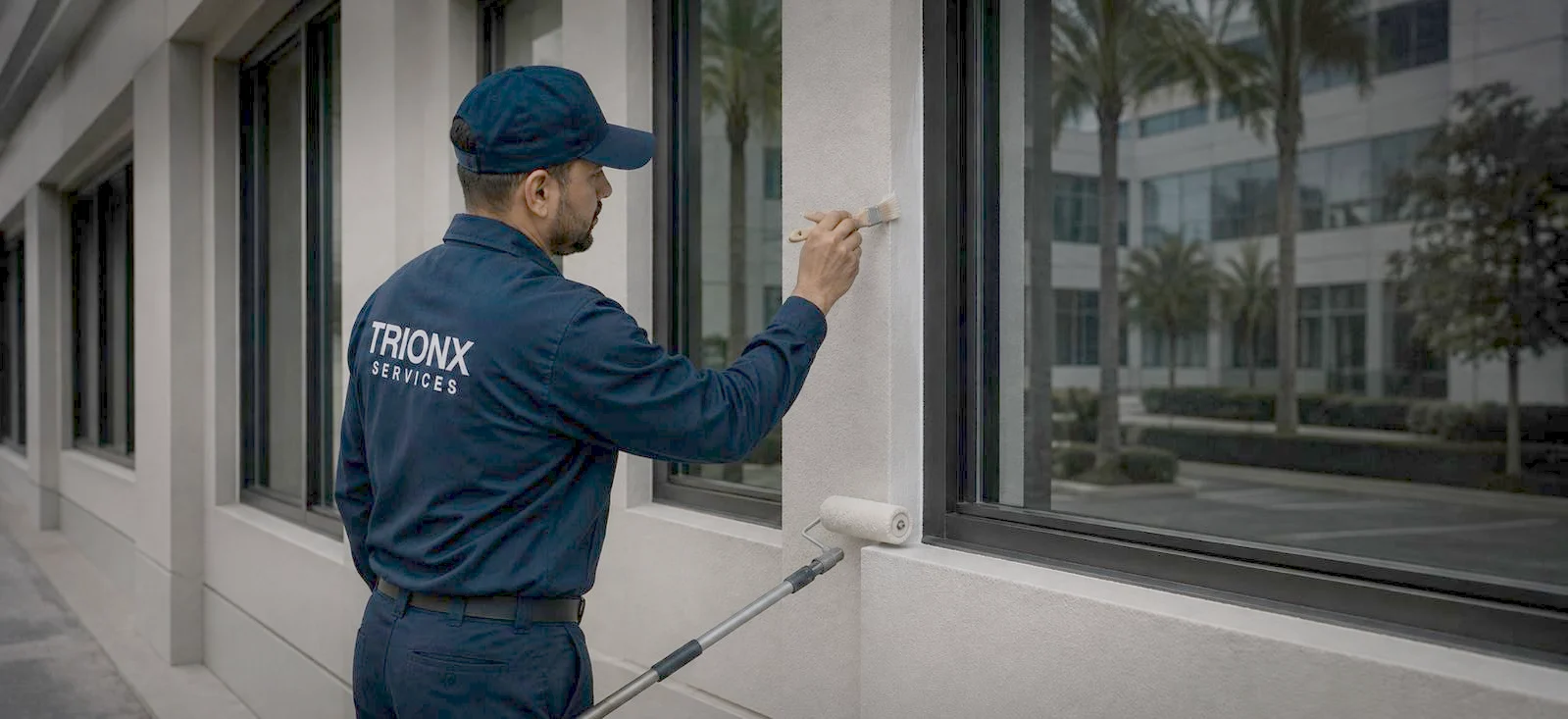
Coating failures on commercial property are preparation failures far more often than product failures. Pressure washing to remove chalk, dirt and growth. Cracks opened, filled and finished. Failed sealant cut out and replaced rather than painted over. Bare and rusted metal taken back and primed. Substrate dry before anything is applied, which in the wet season is the constraint that sets the schedule.
A quote that treats preparation as a line item and a quote that treats it as included are describing different jobs, and the gap between them is where a five year finish turns into an eighteen month one.
When to do the work
The dry season, roughly November to April, gives lower humidity, fewer afternoon storms and a longer usable working day. Wet season work is possible and we do it, though it needs the forecast watched and elevations sequenced around the rain, and it takes longer.
On occupied commercial property the other constraint is the tenants. Restaurant frontages, retail entrances and hotel elevations get worked around trading hours, which is a scheduling problem rather than a painting one, and it belongs in the plan before the quote is signed.
How this sits with the rest of the envelope
Painting is the visible part of a larger job. Caulking and joint sealing keep water out of the openings. Pressure washing keeps growth off surfaces that would otherwise hold moisture. Minor stucco and trim repair fixes what the coating cannot bridge. All of that is performed by our own technicians, and none of it requires a Florida contractor licence.
Where a job turns out to need a permit, or where the underlying problem is roofing or structural, it moves to a licensed contractor and we coordinate it. We say so at survey rather than after the scaffold is up.
Common questions
Questions we get asked about this
How often should a commercial building be repainted in South Florida?
Roughly seven to ten years on inland stucco with a sound substrate, five to seven on coastal or high-exposure walls, three to five on previously coated metal and on wood. Exposure moves these more than the product does.
What are the signs a commercial exterior needs repainting?
Chalking, where a hand run down the wall comes away dusty, is the point at which a wash and recoat is still straightforward. Uneven fading, hairline cracking across stucco, blistering and hollow-sounding stucco run from there to substrate repair.
Can you paint over blistering or peeling paint?
No. Blistering means water is behind the film and trying to escape, so a new coat fails the same way. The moisture source has to be found first, and it is often a failed sealant joint, a blocked scupper or a leaking parapet.
When is the best time to paint a commercial exterior in Miami?
The dry season, roughly November to April, which brings lower humidity, fewer afternoon storms and a longer working day. Wet season work is possible but needs the forecast watched and elevations sequenced around rain, so it takes longer.
Do commercial painting jobs need a permit in Florida?
Ordinary repainting does not. Where a job turns out to need a permit, or where the underlying fault is roofing or structural, it moves to a licensed contractor and TrionX coordinates it. We say so at survey rather than after access equipment is up.
Keep reading
Related field notes
Building a preventive maintenance schedule that survives contact with reality
Caulking and joint sealing: the maintenance nobody schedules
Pressure washing: what it fixes, and what it damages
Condo common elements: association or unit owner

Vendor onboarding: the COI, W-9 and licence packet, item by item
One company, whoever does the work
Our technicians handle the trades that need no state licence, and licensed contractors handle the ones that do. Either way we scope it, book the visit and file the record. Tell us the property and the problem and we will come back with a window.